
Fish played a prominent role in the daily diet throughout the Catholic Middle Ages, because during set periods and days the eating of meat was forbidden. Lent is the most extended and strict period of dietary restrictions, because not only meat, but all animal produce (butter, cheese, eggs) were prohibited foodstuff. On the weekly fast days the…
ORIGIN
Barley soup for a ball

Straight to the recipe Double take The Netherlands celebrated the bicentennial of their existence as a kingdom in 2013. But at the time that was actually 198 years ago, not 200. From 1813 to 1815 the Netherlands were the Souverijne Vorstendom der Verëenigde Nederlanden (the sovereign principality of the united Netherlands). We didn’t have a king, but a prince….
Spinach Pie
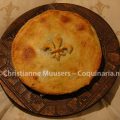
This the third recipe for Good Friday. The other recipes are Pomegranate Salad and Jacobin Sops. If one grows spinach in the kitchen garden, or is from an older generation, one might remember the sharp-edged seeds of some varieties of spinach. Spinach had to be washed very thoroughly to remove all those unpleasant seeds. Nowadays…
Roman patina with herbs

Straight to the recipe In the introduction to the recipe for Roman patina with asparagus and quail I wrote about this dish. On this page is another recipe for patina with asparagus, without meat but with green herbs. I also used green asparagus this time. The cilantro and lovage leaves add a very distinct flavour to this…
Lamb-chops Pie

Straight to the recipe A Dutch recipe from the eighteenth century To serve lamb on Easter Sunday is an ancient custom. Although this recipe is not specifically intended for an Easter meal, this pie will be a great succes when served on the occasion. With a salad or mixed spring vegetables this is an excellent…
Dutch barley soup

Straight to the recipe This barley soup is not French haute cuisine as Carême’s recipe is. It is Dutch and was published in Aaltje, de volmaakte en zuinige keukenmeid (‘Aaltje, the perfect and thrifty cook’), a popular cookery book from the early nineteenth century (1803). In fact it was so popular that in 1887 a teacher of house economics, Odilia Corver, thought to…
Divine wine
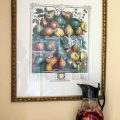
An exquisite drink from the seventeenth century Straight to the recipe During the seventeenth century a meal was often concluded by drinking spiced wine to stimulate the digestion. Hippocras was such a drink, which was already known during the Middle Ages. But there were other kinds of spiced wine as well. Vin des dieux (‘wine of the gods’) is such a spiced wine,…
Nourishing square omelette
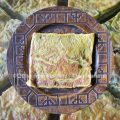
Straight to the recipe Medieval stuffed omelette with marrow Some years ago I prepared a menu in the Culinair-historisch Kookmuseum (‘culinary cookery museum’) in Appelscha in the North of the Netherlands, consisting of medieval recipes with marrow from first course to dessert. The menu was called To the bone (Tot op het bot). The recipe below was one of…
Dutch beef stew or ‘hachee’

Great with mashed potatoes and red cabbage Hachee (pronunciation ɦɑʃeː or hashay) is a traditional Dutch winter dish with beef. It has an almost medieval flavour, because of the use of vinegar and peperkoek (something like gingerbread but not quite the same). Hachee can be served as a separate dish, but I have chosen to prepare an oven dish, with red cabbage and apple on the bottom…
Eggs with gooseberries
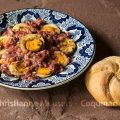
Straight to the recipe An odd but tasty dish Recently I published an article in the periodical De Boekenwereld (The Book World) on Roman Catholic recipes in the eighteenth-century cookery book De Volmaakte Hollandsche Keuken-Meid (The perfect Dutch Kitchen Maid). The indirect cause of that article was a recipe I published on Coquinaria a year ago, a Dish for Lent with prunes…
Vegetarian stock for Lent
Recipes from the seventeenth century During Lent, between carnival and Easter, the catholic church (and after the Reformation several protestant churches as well) restricted the faithful to a meatless diet. During the Middle Ages all diary products were also banned during Lent, later the use of butter was permitted. Almonds were used instead of meat…
Arabian meatballs
Straight to the recipe Tasty tidbits The recipe on this page was prepared, together with Arabian pasties, clareit and medieval wafers, for the opening of an exhibition in the Utrecht University Museum on the medieval text Sidrac. The focus was on the Middle Dutch translation, Sidrac. There is also a late-medieval translation of this text, Sidrak…
‘Gilt poverty’

Straight to the recipe A very simple recipe from ‘the first Dutch television cook’ The information on this page concerns the first decennium of Dutch television. Information on the rather obscure and unique Dutch broadcasting system can be found on wikipedia. There were several member-based broadcasting organizations, each with their own religious or political ideology. Mentioned below…
Clean hands

Coquinaria has lots of medieval recipes, but how do you eat these dishes? With your hands! Eating with a fork became the thing to do in upper class European courts during the sixteenth century. Lower classes kept eating with their hands as late as the eighteenth century. Eating your food with fork AND knife is…
Coulibiac with chicken, a recipe from Carême

Straight to the recipe Russian pastry from the classic French cuisine Coulibiac or coulbac is a traditional Russian pie that has been assimilated in to the classic French cuisine as early as the nineteenth century. The Russian name koulibiac has its origins in German: Kohlgeback (pastry with cabbage). Some versions of coulibiac do contain cabbage. The version with…