
In the Dutch language quinces are called quince apple or or quince pear. According to the sixteenth-century recipe for quince pie, quince apples must cooked and quince pears baked. I am not sure why, the form of a quince makes no difference in the preparation. The recipe on this page is for quince jelly from…
ORIGIN
La Varenne’s meat stock
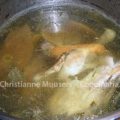
This is the first ‘historical’ recipe for stock on my site. This meat stock is taken from Le cuisinier françois by François Pierre la Varenne, from 1651. It is the opening recipe in the book, a real basic recipe. The stock is made with a lot of meat, and all kinds of it: beef, mutton, fowl. From…
Fresh noodles from Japan and China

People always think first of Italian pasta at the mention of fresh pasta. But many cuisines have a tradition of fresh noodles, sometimes with different ingredients or cookingtechniques. On this page you can learn to make your own fresh Chinese and Japanese noodles. The quantities in the recipes are but guidelines: eggs may vary in size, flour…
Sluberkens
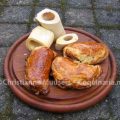
Straight to the recipe Medieval pasties with bone marrow In 2006 I acquired the book Bones by Australian chef de cuisine Jennifer McLagan. The front cover has a splendid picture of roasted marrow bones. This led to my browsing through the editions of medieval cook books on my bookshelves to see whether anything interesting was done with marrow…
The original Waldorf Salad
Straight to the recipe An American classic from the nineteenth century Until the beginning of the nineteenth century, cooks and maître d’s who served at the courts of kings and nobles set the tone in culinary developments. But this all changed with the rise of restaurants and -later- hotels. Who today knows the men or…
Medieval applesauce from England

Greasy! Elsewhere on Coquinaria I have published a recipe for Apple Sauce for Lent. On this page is an English recipe with different versions for meat days and fish days, called apple moys. The Dutch name for apple sauce is appelmoes, so to me (being Dutch) that sounds very familiar. This apple sauce is special…
Cook’s Salmon Salad
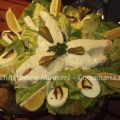
Straight to the recipe Simply delicious A delicious recipe amalgamated from two nineteenth century cookbooks written by ‘kitchen maids’. In eighteenth century England the housewife or her housekeeper ruled the cookbooks, in The Netherlands it was the keukenmeid (litt. kitchen maid), which is not quite the same as the housekeeper but more a female cook. However, I will use that in the translations…
Red cabbage the Dutch way
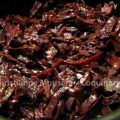
Straight to the recipe A nineteenth-century recipe with apples and apple syrup Originally I had planned a completely different recipe for this month, but then I noticed this old-fashioned recipe for red cabbage in a Dutch cookery book from the middle of the nineteenth century: Betje, de goedkoope keukenmeid. (Betje, the Cheap Cook). It is the…
Peperkoek, the Dutch version of gingerbread
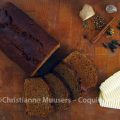
A delicious treat This ‘pepper cake’ is very popular in the Netherlands, and is known under several other names, like ontbijtkoek (breakfast cake) and kruidkoek (spice cake), or connected to regions like Groninger koek or Deventer koek. It is promoted by the food industry as a healthy snack, because it contains no fat. However, sweeteners like honey and sugar constitute more than 50% of…
Pickle Herring, the ‘forgotten fish’

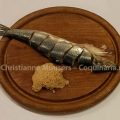
It is time to change that! In February 2016 I organized a cookery course for the first time in nearly ten years, with members of the re-enactment group Het Woud der Verwachting (litt: ‘the forest of expectation’, after a historical novel by the Dutch author Hella Haasse). The menu was in concordance with the date of the course:…
All about chopsticks

In many Asian countries people use chopsticks for eating their food. But there are differences, just as in the western world Americans wield knives and forks in a different way as Europeans. I have a small collection of chopsticks and chopstick rests (nothing special, but I enjoy it nonetheless), and thought it would be nice…
Dutch muffins with speculaas spices
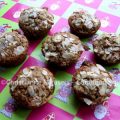
There are two kinds of muffins, English ones, and American muffins. Muffins originate from England, but are also very popular in the United States. They were first mentioned in the eighteenth century.The English muffin is made from a yeast-dough that is baked on a griddle on the stove instead of in the oven. After baking…
Strawberye
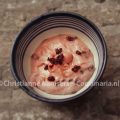
Straight to the recipe Medieval pudding with strawberries from England Medieval recipes for summer fruit are rare. Strawberries, raspberries, brambles, blue- and blackberries: they were mostly eaten as we like to eat them, ‘straight from the bush’. Of course you do not need a recipe for that. According to the medieval health regime the eating…
Medieval mustard
Straight to the recipe Mustard has always been a popular condiment. Mustard is made from the seeds of several species of the brassica-family (cabbage). From some varieties the leaves can be eaten, and the seeds not only serve to make mustard, but can also be pressed to yield a culinary oil, or distilled to make…
Roman sourdough bread

The Romans knew several kinds of bread. Mostly these breads were made with sourdough. The meal that was used was wheat, spelt, barley or rice. Even ground pulses were used. In the second century before Christ bread started to displace pulses as basic food. Bread was eaten every day, at every meal. This explains the…