
Straight to the recipe A medieval first course from Germany I am lucky with my neighbours. At the moment, I live next door to the core of the musical group EnsembLeChatNoir, who give beautiful – and sometimes multimedia – concerts. At my previous house there was also an artistic neighbour, a cermist. She is from Germany, and…
Meat nor fish (vegetarian)
Arabian pasties

Straight to the recipe Just like the Arabian meatballs, these pasties were presented at the opening of the exhibition of Sidrac in 2006. The pasties are stuffed with eggplant from the Anonymous Andalusian Cookery book, and spinach from the Kitāb al-Ţabīkh-al-Baghdadī. Both cookbooks date from the thisrteenth century. More on the Andalusian cookbook can be read at the…
Mock eggs for Lent

Just for fun Straight to the recipe This an extra recipe with the Medieval coloured easter Eggs. During Lent, between carnival and Easter, no eggs were eaten. But sometimes eggs did appear on the table, as a joke. These were mock eggs, made with pike roe (also eggs, but from fish, so these were permitted) or…
Vegetarian cutlets from World War I

Straight to the recipe Recently a book was published containing the biography of the Dutch chef Iwan Kriens (1871- ca 1957) who had a very succesful career in England. To honour the occasion, this page contains a recipe from The Victory Cookery Book, which he wrote with Mrs C.S. (Dorothy) Peel in 1918. Kriens already had…
Crème brûlée

Straight to the recipe An all-time favourite from the seventeenth century Crème brûlée is one of the most popular desserts. That probably has to do with the titillating contrast between the cold, creamy custard and the hard, hot layer of burned sugar. This dish should be prepared with care, because it can easily turn out wrong….
The day all France was vegetarian

Straight to the recipe Jean-Louis Flandrin, who died in 2001, wrote in his posthumously published book L’Ordre des mets that the reformation had such rapid succes in North-West Europe because of the prohibition of butter by the catholic church during Lent. Southern Europe used olive oil anyway, but in the North-West suet, lard and butter were the…
Dashi

Recipes for Japanese stock Dashi is the basic stock of Japanese cuisine. It can be prepared in several manners, but mostly dashi is made with seaweed and dried bonito. Below there are several recipes for making dashi. When preparing noodlse, use Japanese noodle bouillon. The two main variations of dashi are ichiban dashi and niban…
Home-made vegetable stock

Stock gets most of its taste from meat and bones (poultry, cattle or fish). What to do if you are vegetarian? This vegetable stock has an incredibly rich taste, without the help of salt, meat or stock cubes. Even real carnivores will appreciate this stock. You can use it for soups and sauces, and of…
Tortelli in brodo

Straight to the recipe An Italian recipe from the sixteenth century This is a real classic from the Italian kitchen: stuffed pasta in broth. The sixteenth century recipe prescribes the use of meat broth. If you replace this by a good vegetable broth, the result is a very tasty vegetarian dish. It is best not…
Purée from broad beans
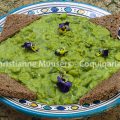
Straight to the recipe This recipe for broad beans is taken from the sixteenth-century cookbook Opera by Italian Bartolomeo Scappi (see bibliography). more on Scappi and his book: Tortelli in brodo and Broccoli in de Opera). In the Libro Terzo (Book III, with recipes for Lent and fish days) of this cookbook is the following recipe for minestre (a first course, thick soup or pottage)…
Aubergines for cardinals
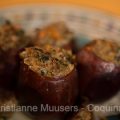
Straight to the recipe One year ago I published a Dutch recipe for stuffed aubergines from the 1970s. This historical recipe is also for stuffed aubergines, but older; it was published 450 years ago. The cardinals were the intended public that Bartolomeo Scappi, author of the cookbook that the recipe originates from, cooked for. More…
Imperial cucumber
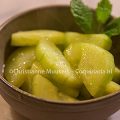
Straight to the recipe Great with Roman tuna Pliny the Elder (23 – 79 AD) describes in his encyclopedia Naturalis historia everything that live and exists on Earth. Originally there were 102 volumes, but unfortunately only 37 have survived. These 37 volumes include the ones on animals and plants, so we can still read what Pliny had to…
Aubergines in aubergine sauce
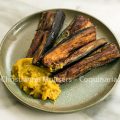
This recipe for aubergines (eggplants) with aubergine sauce was chosen because of the possible connection with an Arab recipe with aubergines. It is from an Italian cookbook from the end of the fifteenth century that has been published by Terence Scully as The Neapolitan recipe collection. ‘Cuoco Napoletano’ (see bibliography). The Southern part of Italy has been…
Fake Fish
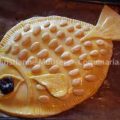
Straight to the recipe Medieval apple pie for Lent Lent – The fishy season In the Middle Ages the catholic church prescribed what was on the daily menu. Each week counted at least one day, and more often three or even four days (depending on where and when in medieval Europe) during which no meat…
Roman broccoli
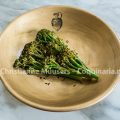
A recipe for broccoli from De re coquinaria, a Roman cookbook with recipes from the 1st to 4th centuries. If a vegetable like broccoli already existed, it was probably something that looked like Brassica rapa var. Cymosa, also known as Cima di rapa or rapini (broccoli raab): thin stalks with leaves and small flowerbuds. Where I live (the Netherlands), Cima di…